Home of the Puca

My search for distinctive Irish High Crosses brought me to Blessington in west Wickow, a noted beauty spots near Dublin in the 18th century. Its waterfall on the River Liffey was mentioned on an 1752 map as 'Poolapooka - a remarkable cataract’.
Poulaphouca, Poll a' Phúca in Irish, means 'the Púca's hole', a Puca being the legendary semi-human with a tail and animal ears. If possible it was to be avoided.
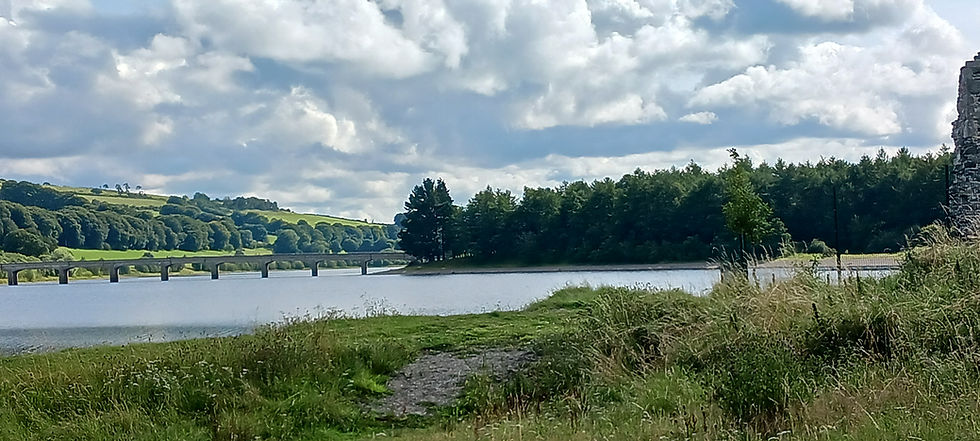
Life there changed in 1937 when a hydroelectric scheme dammed the Liffey creating a reservoir. The ‘remarkable cataract’ shrank and the fate of the puca is uncertain. A 5,500 acre lake was created with the ridge of Valleymount spectacularly dividing it in two.
You might think that the lake and its surrounding hills would be a popular ‘day out’ for the people of Dublin but maybe because it is ‘artificial’ it remains remarkably quiet, and beautiful.
When the valley was flooded villages, houses and farms were submerged but the ruins of the ancient church and tower house at Burgage survived because they are just above water level.
I went there to read what the ‘Irish High Crosses of Burgage More’ had to say. While the church and tower are marked on local maps, for a visitor like myself the directions were too vague and most of the people I met did not know they even existed.
Eventually I found my way and the view of the lake alone made the search worthwhile, the ruins of the tower and church complete the picture. Once this had been a busy monastic settlement consisting of St Mark’s Church, a holy well, a number of high crosses, a tower house and a cemetery. It is believed to have been founded by St Baoithin in the early 7th century and remained the centre of a self-sufficient riverside community until Norman times.
The crosses are no longer there. They, and many of the graves around the church, were moved for safety from the rising waters to a cemetery some miles away. I found them, near Blessington.
The ‘Burgage More High Cross’ is distinctive but not enough to attract many admirers. Its present location in a suburban setting does not add to its stature. Its ringed head is not perforated and the top is unusually short. Lettering in old Irish on the base is now barely discernible.
St Mark’s cross was originally known as St Baoithin’s. Where the Normans ruled they preferred non-Irish saints and rechristened it St Mark’s. Baoithin was Irish, one of eight members of a famous west Dublin/Kildare missionary family. Mochua of Celbridge (Cell at Bridge) was one of his brothers and St Cainnear of Clonsilla was their mother.
Yet the modern sign at St Mark’s Cross says St Molomma (‘Our Lomma’), whose name is remembered in nearby Kilmalum (Cell of Moloma), was the patron of Burgage. (I have noticed that the problem with early Irish history is that there is so much of it.)
I was happy to have found the crosses, though disappointed by their simplicity. However I enjoyed the walk, the views of the lake, imagining the monastery when it stood on the banks of the Liffey and encountering a family of pioneering saints I had known previously. As for the pucas, it seems they might be beyond hope of even being considered an endangered species.


Comments