Most Beautiful Holy Well?
- Hugh MacMahon
- Jan 21
- 2 min read

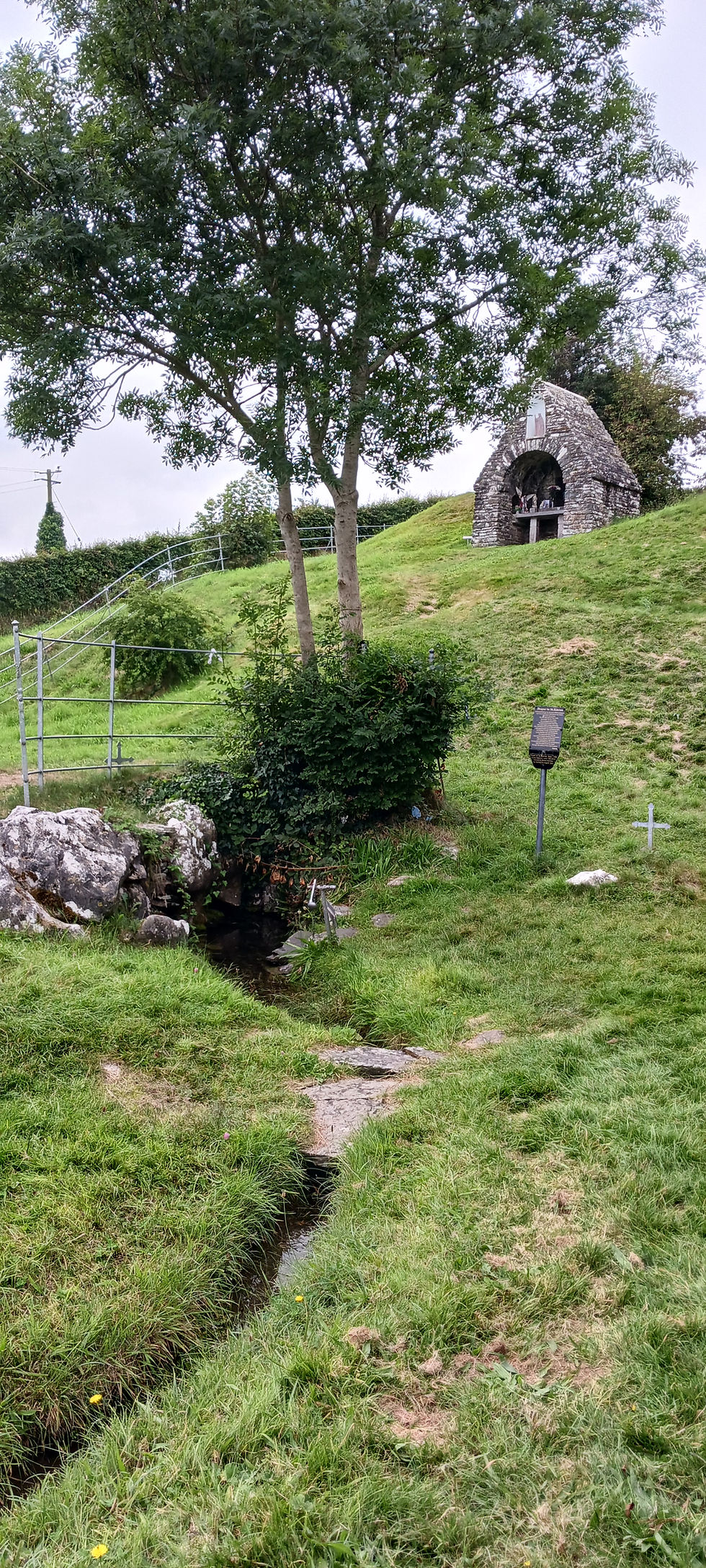
In 1849 Sir William Wilde, surgeon, archaeologist and father of Oscar Wilde, described St Ciaran's Well at Castlekeeran as the most beautiful holy well in Ireland.
The wells (there are at least three of them) emerge from the side of a grassy hill to cascade down rocky channels to the stream below. A simple bridge across the stream and the replica of an early Irish oratory on the hill above complete the picture.
Despite being on a country road the surroundings are quiet and everything except the oratory and bridge remain as they were when our ancestors first saw them thousands of years ago.
People returned to wonder at the water emerging dramatically from the rock and benefit from its healing powers. A long-lasting tradition of pilgrimage began that lasts to the present day.
Such wells have stories, often associated with fish and wisdom. In Castlekeeran it is about three trout. They were so widely respected that what Christianity came they were baptised with the names Faith, Hope, and Charity.
On the eve of the annual fiesta or pattern (the first Sunday of August) the trout came to the surface of the well. They were safe there from locals but a visiting fisherman, unaware of their significance, trapped them and prepared to make a meal of them They immediately jumped out of the pan and told him, ‘Leave us back where you got us’.
Today there is no sign of the trout but the wells remain almost untouched. The main spring has steps down to it and there is a ‘holy tree’ close by. To the right is a bench where people would sit with their feet dangling in the water. Of the other two, one is referred to as the ‘chair’ and is known to offer pilgrims relief from back pains. The other is called the ‘healing well’ and dispenses water on two sides of a stone.
The stone oratory on the top of the hill was built in 1914 as a reminder that ‘Ciaran the Pius’ built his cells nearby either to avail of the water supply (every community needed a reliable well) or perhaps to share in the sacredness of the site. At any rate, he gave his name to the well. The remains of his ‘diseart’ home and its termon crosses are a few hundred yards further up the road.
Because of large gatherings on pattern days, holy wells were often availed of for political or nationalistic purposes.
In the aftermath of the 1916 Uprising pilgrimages at such site coincided with political gatherings and anti-conscription rallies. In August 1917 the Meath Sinn Fein Clubs held a public meeting on the pattern day of St Ciaran’s Holy Well. Upward of 10,000 people were present and following prayers at the oratory a Sinn Fein meeting was held in a field close by. The gathering was addressed by national leaders Countess Markievicz and Sean Milroy and ‘a large number of priests were present on the platform’. A plaque celebrates the event.
Is there a more beautiful holy well in Ireland?


Comments